HAʻAHAʻA AND LISTENING TO YOURSELF

Kuʻia ka hele a ka naʻau haʻahaʻa #1870

Hesitant walks the humble hearted. [A humble person walks carefully he will not hurt those about him.]

Pukui, Mary Kawena, (1983). ʻŌlelo Noʻeau

ALOHA FOCUS FOR THE WEEK: HAʻAHAʻA 

“If I asked my father a question when he was quiet, he would say he was having a conversation with himself and that I shouldn’t interrupt.”

Ann Patchett, The Dutch House

When I taught at Kailua High School, my colleague, Mr. Unten made it his mission to teach his students how to have a conversation with themselves. He’d ask, before you got in trouble for fighting, before you even punched that guy, what did you tell yourself? Most students replied that they didn’t know what he was talking about. They did not have an internal dialogue, no Jiminy Cricketsitting on their shoulder telling them to choose right from wrong or to even weigh the consequences. They just acted, ignoring their under-developed pre-frontal cortex, the part of the brain behind decision-making and emotional regulation.

Consequently, these students kept on getting into trouble. Even at 9th grade, more than a few were arrested for stealing, fighting, and vandalism. One even punched a police officer. After spending a lengthy time in detention, the student told me that he wasn’t thinking. He was raised to fight back no matter the situation. And so, when the officer shoved him, he balled up his fists and automatically swung.

Mr. Unten, an English teacher, provided many models for students to learn how to listen to what their gut was telling them. He led his class in discussing novels, such as The Giver, examining what might be going on in the characters’ heads. He had students explore their own dilemmas and practice thinking through situations. He taught them that the answers to their problems lay within themselves. They just needed to listen.

The kūpuna advised listening to one’s ʻōpū or naʻau. They believed one’s disposition was guided by the small intestines. Whether one chose to commit moral or harmful acts was determined in one’s gut. To the kūpuna, the ʻōpū was synonymous with one’s heart. Modern science, to some extent agrees. Scientists have found that there is a nerve that directly connects the brain and the gut, creating a hotline between the two organs. Beyond signaling when the gut is hungry or full, this nerve (called the Vargas nerve) allows the gut to influence our moods, and when dysfunctional, can contribute to depression and anxiety. The gut also affects our memory and attention – that’s why kids who come to school hungry often have a difficult time focusing and learning.

If Mr. Unten were still teaching English or perhaps in his new role as the principal of Kapunahala, he might ensure students are first well fed. Then he might advise them to take some time to sit/stand/walk in quiet, be haʻahaʻa and listen to their naʻau. Maybe then, they can make better decisions, find solutions to their problems, and discover greater happiness…all within themselves.


5 PURSUITS of HAʻAHAʻA 

Inspired by Gholdy Muhammad

Please watch this: Listening to My Body written by Gabi Garcia and illustrated by Ying Hui Tan. Then with you child, answer the following:

  • IDENTITY: Different cultures have sayings or beliefs about listening to your body. Hawaiians talked about trusting your naʻau. Likewise the Japanese referred to their bellies as hara which also meant gut instinct. Talk to your kupuna about what your culture taught about gut instinct.
  • SKILLS: The author uses pounding a drum as a simile for a hearth beat. Come up with a different simile to describe a heart beat.
  • INTELLECT: What are sensations? Use examples from the text to come up with a definition.
  • CRITICALITY: How does listening to your body help you make better decisions, especially when you are frustrated or angry?
  • JOY: With your kupuna or makua, try the different suggestions for practicing listening to your body. 

Why it’s important to read aloud to your kids—even after they can read themselves

Do you read to your child? A recent study has found great benefit to continue reading aloud to your kids even as they get older and can independently read. It builds vocabulary, comprehension, and fluency, while also strengthening emotional bonds. The content can vary—books, poems, or news—and even short daily sessions can make a big impact on a child’s development. So as we get transition into summer, we encourage you to read aloud to your child or even take turns reading with them and even join the Hawaiʻi State Library’s Summer Reading Challenge: E Heluhelu Kākou: Let’s Read! – When you log reading in June and July, you’ll unlock more rewards and earn a shot at winning four round-trip tickets on Alaska Airlines!  

Ways to Connect Elementary Math to Everyday Life

Let’s not forget that we can also build students’ math skills during the summer break. It need not (and I would even say should not) be worksheets and drills. Instead, you can have your child practice their math by setting up playful activities built around creativity and real-world relevance that bring math to life in a whole new way. See these resources for great ideas to implement at home: Make Ooblek; Make and play with Baker’s Clay; and see these 11 Real World Math Activities.


CONTINUED PRACTICES:

NOʻAHUNA OF ALOHA

See Uncle Pono Shim explain the Noʻahuna, the esoteric meaning, of Aloha as taught to him by Aunty Pilahi, the Keeper of Secrets.

WEAR KĀNEʻOHE SHIRT WEDNESDAYS

Help us build unity and show our lōkahi by wearing a shirt that celebrates Kāneʻohe on Wednesdays. Wear any previous Fun Run or grade level shirt.

DAILY VIRTUAL PIKO

At the Daily Piko, we share thoughts on the Aloha value for the week which helps us become centered and ready to learn. We begin at 8 AM everyday except Wednesdays when we meet in-person. If you would like to share your reflections on the week’s Aloha value, please contact me.


UPCOMING EVENTS

May 28KES SCC Mtg – In-person @PCR
4:30 – 5:30 PM
May 296th Grade Promotion Ceremony @Cafe
6:00 – 7:00 PM
May 30End of Year Awards Ceremony @Cafe
8:30 – 9:30 AM
May 30Last student day
End of 4th Quarter/Spring Semester/SY 2024-25

ʻOLUʻOLU AND MOTIVATING CHILDREN

Good natured; not easily provoked; good humored as applied to a nature of ease and cheerfulness. 

Parker, A Dictionary of the Hawaiian Language, 1865

ALOHA FOCUS FOR THE WEEK: ʻOLUʻOLU

Yesterday, my aunty invited Gen, my mother, and I to have breakfast at her retirement community. She wanted to celebrate Gen’s graduation since she could not attend the ceremony in person. At breakfast, an elderly woman at an adjoining table, complimented Gen on his good looks. When I was his age, I would’ve been flushed with embarrassment and negated the compliment. By contrast, Gen simply smiled and thanked the woman.

As a kid, whenever an adult paid me a compliment, my cheeks reddened and for some odd reason, my nostrils flared. Looking so odd, my friends or cousins that were nearby would tease me to no end. It didn’t help that I had this same look when I was about to win a game which eliminated my chances if bluffing was part of the strategy. Consequently, I learned to downplay any compliments I received. This coupled with a cultural value that one should not be prideful, I did not feel confident about how I looked or anything I might have been good at.

As an educator and later as a parent, through research and a lot of trial and error, I learned to avoid having my children experience the same negative association with compliments. Selective in my praise, I always gave it in private. I wanted to let my kids know I recognized their gifts and that it need not be for anyone else to hear. 

I also learned to let them own their gifts and have the confidence to make the right decision for themselves. When my daughter Zoe, as a team captain, decided to quit the varsity soccer team in protest of how she and her teammates were being treated, my initial reaction was disappointment. I loved seeing her play and show no fear as a goalie. Yet, I recognized that quitting in protest was also an act of courage and an even greater one than could ever be expressed during any single game. I could not be prouder.

Today, Zoe lives across the country, pursuing a degree that derived from a compliment Grandma Sadie gave to her as a middle schooler. As my mother recovered from surgery, she noticed how her Occupational Therapist held similar qualities to Zoe – brave, a love for helping others, strong, athletic, patient, and kind. She shared this with Zoe and it stuck. She began to feel the confidence needed to pursue this career.

Author and educator Russell Shaw calls this: helping children find their “islands of competence.” In an article on motiving children, he asserts that if we want to build self-motivation in children, then we need to emphasize the good we see in them and cultivate their strengths. Too often, we focus on the lowest grade on their report card or see only the areas in which they are lacking. Research has shown this negatively affects confidence and leads to heightened stress and avoidance behaviors. Instead, Shaw recommends following these simple steps:

  1. Identify the island: All kids excel in various things; their “islands of confidence”. Sometimes they find it on their own and other times they might need to be introduced. Regardless, when children feel confident in one area, they are more likely to be resilient in other more challenging ones.
  2. Name it: At times, kids do not see the value in their own strengths, falsely assuming everyone is good at it or thinking that it’s nothing. However, when someone recognizes and names that strength, they see themselves differently and will strive to hone that strength.
  3. Build on it: In numerous instances, from athletes to musicians, we see innate talent is not enough. Hard work, dedication, and deliberate practice toward mastery is the key towards long-term confidence and perseverance. Shaw advises, “The important thing is to suggest an activity to kids and not force it on them, which could backfire and turn into resentment.”
  4. Use strengths to address weaknesses: Confidence stemming from a strength, can help kids overcome challenges in other areas. They might even leverage their strengths to contribute in ways yet unseen. For example, despite being an introvert, Gen’s love of music coupled with his experiences as a boy scout has helped him to excel as a section leader in band and create bonding experiences for his team. 
  5. Tell an optimistic story: The stories we hear are impactful and have lasting influence. At times I still struggle to accept the compliments I heard that were followed by derisions on my looks. Even in the classroom, we hear kids say, “I’m not  good at math” or even “I’m stupid” or “Iʻm bad.” These narratives have a way of becoming self-fulfilling prophecies. By contrast, when we celebrate strengths, children see themselves in the positive, develop greater confidence, and become more motivated to cultivate those strengths. 

From social media to negative stories in the press, we feel pressure to push our kids to achieve. Too often, it drives to focus on fear and correction. But as Pono Shim would advise, let’s focus on connection not correction. By cultivating “islands of competence” we better connect with our children and help them become more confident, resilient, and motivated.

Shaw, R. (2025, May 12). The wrong way to motivate your kid. The Atlantic. https://www.theatlantic.com/family/archive/2025/05/parenting-islands-of-competence-kids-motivation/682739/ 


5 PURSUITS of ʻOLUʻOLU

Inspired by Gholdy Muhammad

Please watch this: Hana Hashimoto: Sixth Violin written by Chieri Uegaki and illustrated by Qin Leng. Then with you child, answer the following:

  • IDENTITY: Like Hana’s ojichan skill with the violin, ask your kūpuna to share a talent they possess. What is a talent their kūpuna possessed?
  • SKILLS: “Hana swallowed her nerves like medicine.” What do you think the author means by using this simile?
  • INTELLECT: What is a symphony orchestra? Other than a violin, what other instruments perform in a symphony orchestra?
  • CRITICALITY: What can we learn from Hana’s decision to keep practicing and performing even when facing ridicule from her brothers? 
  • JOY: Try a new learning a new skill and perform for your ʻohana. Remember that it takes time, dedication, hard work, and practice to master a skill. But one’s confidence grows from performing, even when still learning.

MAHALO NUI LOA – STEM HŌʻIKE

Over the past 8 years, our STEM Hōʻike has grown to become an essential component of our school’s identity. By teaching the Engineering Design Process to address problems all around us, our teachers inspire students to explore engineering as a viable career option. Our teachers dedicated a lot of care into preparing their students and ensuring all who came to visit saw the value of their lessons. Visitors including Senator Keohokolole, Representative Kitagawa, and UH College of Engineering Dean Brennon Morioka were duly impressed with our students poise and the rigor of thinking. 

We thank our parents and members of our ʻohana who took time out of their busy days to visit our classrooms and see our students’ projects. Your support communicates how important learning and dedication is to you and your family. Mahalo for this critical message that relay to your keiki.

We also thank all of our staff from our cafeteria to our custodians to our office to our educational assistants to our admin staff who helped make the day run smooth. Also in the background, but critical to the hōʻike’s success, is STEM Resource Teacher, Karen Kimura. Thrice retired, Aunty Karen is at the heart of all of our STEM accomplishments: coaching teachers, guiding students, organizing the day, welcoming our VIPs. We are so fortunate to have her as a resource at our school.

CONGRATULATIONS CLASS OF 2025

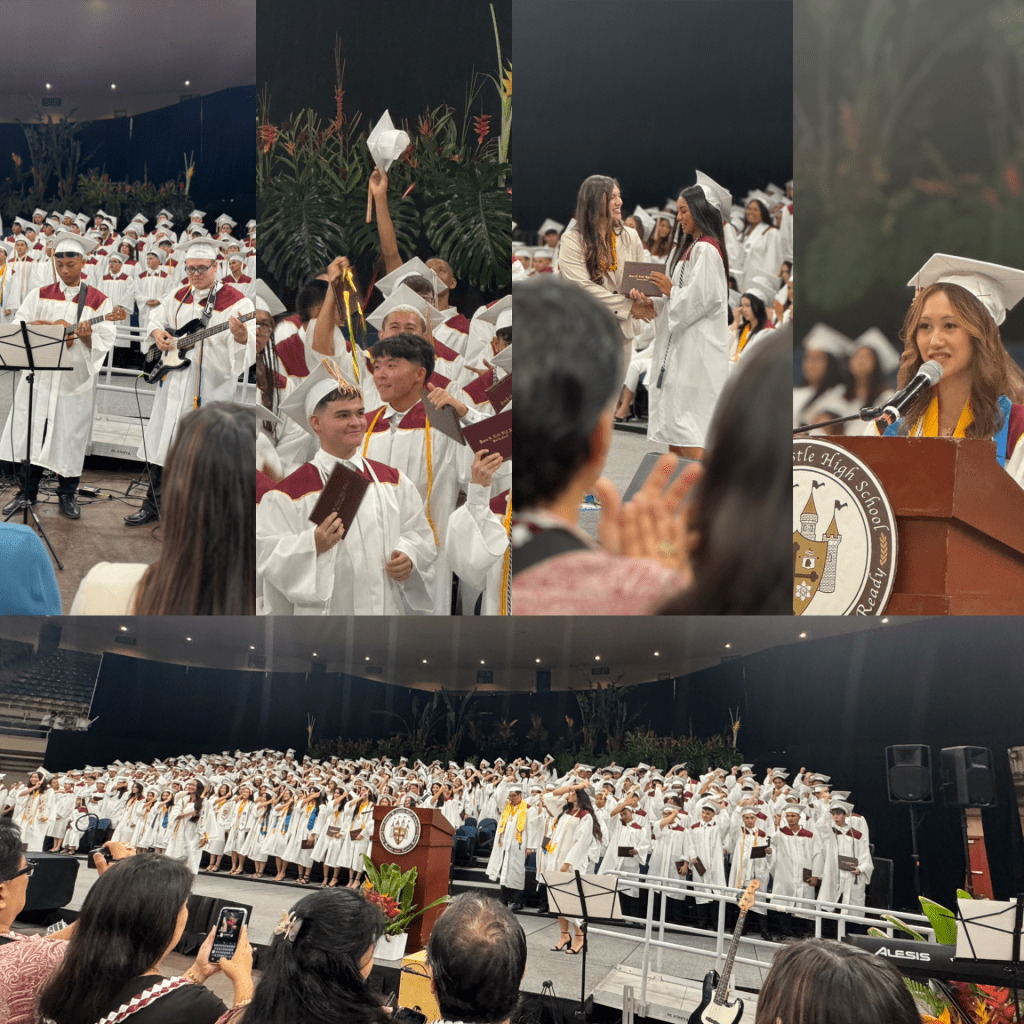
On Saturday, Castle High School celebrated the graduating seniors of the class of 2025. We are especially proud of former Kāneʻohe Elementary Menehune who helped the class attain numerous honors and over 3 million dollars in scholarships. Notably, we congratulate valedictorians Emily Robins and Paige Namahoe-Maeda.

CYBER-BULLYING: PARENT’S GUIDE

On Tuesday, May 20, Tuesday, 12 noon – 1 PM, please see this Zoom presentation by Mental Health America-Hawaii. It is designed for parents, guardians and care givers to gain knowledge and skills to help stop and prevent cyber bullying. It will cover the impact of cyberbullying, signs  and recognition of its occurrence, how to help the target of cyberbullying, what to do if your child is cyberbullying, prevention methods, and helpful resources. To register, click here: Cyberbullying: Parents’ Guide

Registration closes on May 20, 2025 at 11:00 am.

If you have any questions, please contact Sam Waldrop at sam.waldrop@mentalhealthhawaii.org


CONTINUED PRACTICES:

NOʻAHUNA OF ALOHA

See Uncle Pono Shim explain the Noʻahuna, the esoteric meaning, of Aloha as taught to him by Aunty Pilahi, the Keeper of Secrets.

WEAR KĀNEʻOHE SHIRT WEDNESDAYS

Help us build unity and show our lōkahi by wearing a shirt that celebrates Kāneʻohe on Wednesdays. Wear any previous Fun Run or grade level shirt.

DAILY VIRTUAL PIKO

At the Daily Piko, we share thoughts on the Aloha value for the week which helps us become centered and ready to learn. We begin at 8 AM everyday except Wednesdays when we meet in-person. If you would like to share your reflections on the week’s Aloha value, please contact me.


UPCOMING EVENTS

May 21KES Ohana Mtg – in-person @KES Library 5:30 – 6:30 PM
May 28KES SCC Mtg – Online @Zoom 4:30 – 5:30 PM
May 296th Grade Promotion Ceremony
May 30End of Year Awards Ceremony
May 30Last student day End of 4th Quarter/Spring Semester/SY 2024-25

LŌKAHI OF DISCOVERING YOUR PASSION 

A desire for harmony from within and from that peaceful place looking for the “one story” or the “story from heaven’s perspective” where there are no sides (walls, prejudices, biases, silos, agendas).

Pono Shim

ALOHA FOCUS FOR THE WEEK: LŌKAHI

When asked to identify the one quality that all successful entrepreneurs share, world renowned chef Ferran Adrià at first replied, “That’s impossible to answer, there are so many paths to success.” But after taking a beat, he countered, “I take it back. There is one thing that all successful entrepreneurs have in common, and that’s passion.” (Source: Gallo, C. (2016). The storyteller’s secret : from TED speakers to business legends, why some ideas catch on and others don’t. St. Martin’s Press.)

My son Gen, my co-star in all of our Silver Linings Day videos, graduates from Roosevelt High School in a little more than a week. He is set to attend a piggy bank decimating college on the opposite end of the continent. Like many people his age entering college, Gen has a major in mind but no clue if it’s really for him. The career inventory he took last year suggested architecture or engineering, but he possesses little exposure to those fields. The bills have yet to mount, but I am already concerned that those careers might not be his passion.

I would be lying if I said I could not relate. I started my college career pursuing a degree in Civil Engineering. I then switched to pre-med but kept falling asleep in my classes and hated memorizing chemical formulas. I toyed with the idea of becoming a lawyer, but was overwhelmed by the amount of memorizing one had to do. Finally, nearly five years of college later and days before graduation, I realized my passion for teaching. Not just a passion, but what Apple founder Steve Jobs characterized as something that makes my heart sing. 

Similar to other teachers, I loved helping students find joy in what we were learning. Beyond seeing their eyes light up, I felt gratified when students expressed how much fun they had picking up material they at first found intimidating. Teaching freshmen physics, many students entered my class convinced science was boring and laborious. So my goal was to change their minds. I knew they needed to experience the concepts in order to truly understand, so we did many labs and competitions. We applied physics by punching through wooden boards, launching hot air balloons and using lasers to secretly listen in on conversations a building away. I strived to make science wondrous and spark curiosity. Years later when students returned to share what they remembered from my class or even tell me that they were inspired to pursue physics as a career, my heart sang.

I realize that finding what makes one’s heart sing AND being fortunate enough to earn a living from it is easier said than done. Still, like other parents, I want the best for my children and am loathe to see them suffer. While I prematurely worry for Gen, I remind myself that I held similar concerns for my daughter Zoe and today she is only a year away from earning her doctorate. Though they are very different children, they both possess a strong sense of themselves and are self-driven. I should not fret, and seeing them succeed in life mostly on their own definitely makes my heart sing. 

Congratulations to all who have children transitioning to their next phase of life. I wish them (and you) well with many reasons to make your hearts sing.


5 PURSUITS of LŌKAHI

Inspired by Gholdy Muhammad

Please watch this: Surf War!: A Folktale from the Marshall Islands written by Margaret Read MacDonald, and illustrated by Geraldo Valerio. Then with you child, answer the following:

  • IDENTITY: Talk with your kūpuna about your ʻohana’s relationship to the ocean. What ocean activities does your family enjoy and/or rely on?
  • SKILLS: Identify the author’s purpose. Use evidence from the text to support your answer.
  • INTELLECT: Where are the Marshall Islands relative to Hawaiʻi? Research their culture and relationship to Hawaiʻi.
  • CRITICALITY: Recently, the president signed an executive order allowing deep-sea mining off the shores of Hawaiʻi. How might this impact our waters, marine creatures, and cultural practices reliant on the ocean? 
  • JOY: With your ʻohana, participate in a beach clean-up. See 808cleanups, Sustainable Coastlines Hawaiʻi, The Surfrider Foundation or One Ocean for upcoming events.

Here’s another version with a fuller view of the pages or see a traditional telling of the tale here.


MAHALO PIHA – STAFF APPRECIATION WEEK

Dear KES Ohana – On behalf of the staff of Kāneʻohe Elementary, please accept our heartfelt gratitude for the generous gifts of appreciation, many kind words, and expressions of aloha you’ve provided over the past week. Our families are one of our greatest strengths and we feel are truly blessed to be teaching your children.


CONTINUED PRACTICES:

NOʻAHUNA OF ALOHA

See Uncle Pono Shim explain the Noʻahuna, the esoteric meaning, of Aloha as taught to him by Aunty Pilahi, the Keeper of Secrets.

WEAR KĀNEʻOHE SHIRT WEDNESDAYS

Help us build unity and show our lōkahi by wearing a shirt that celebrates Kāneʻohe on Wednesdays. Wear any previous Fun Run or grade level shirt.

DAILY VIRTUAL PIKO

At the Daily Piko, we share thoughts on the Aloha value for the week which helps us become centered and ready to learn. We begin at 8 AM everyday except Wednesdays when we meet in-person. If you would like to share your reflections on the week’s Aloha value, please contact me.


UPCOMING EVENTS

May 15STEM Hōʻike2:20 – 3:50 PM
May 21KES Ohana Mtg – in-person @KES Library5:30 – 6:30 PM
May 28KES SCC Mtg – Online @Zoom4:30 – 5:30 PM
May 296th Grade Promotion Ceremony
May 30End of Year Awards Ceremony
May 30Last student dayEnd of 4th Quarter/Spring Semester/SY 2024-25

AKAHAI AND YOUR LEGACY 

Aka, with care, and hai, to speak. To be tender of heart; meek

Andrews, Hawaiian Dictionary, 1865

ALOHA FOCUS FOR THE WEEK: AKAHAI

More than 400 people gathered to pay their respect, about a hundred more than there were seats available. As I approached the venue, bursts of laughter and smiles on the teenagers hanging around the perimeter of the pavilion gave me pause. Was I in the right place? Was this a graduation party? Then I saw the warm, sympathetic faces of my friends at the reception table.

Over the past two months, peculiarly I’ve been to five funerals, three of which memorialized someone who passed away way too young. This service stood out as it was for a boy just a year older than my son. Genuine, loving, good natured, this young man’s life was just opening up with promising opportunities. But life can be at times random and much too short.

Unlike the afternoon commute there, traffic flowed smoothly as I drove home from Mililani. I allowed my mind to wander, reflecting upon the service filled with funny, touching, thankful anecdotes from his friends, teachers, and sisters. Still, when in the reception line, my lack of words for his parents seemed to emptily echo. Instead tears filled the space between us as we embraced. If it were me, I am not sure what words would alleviate the heaviness crushing my heart.

Pulling off of the freeway, I decided to take a shortcut up a narrow lane that allowed only one car to drive in either direction at a time. Normally, at this time of night, the lane is clear with everyone tucked in at home. However, I saw several brake lights up ahead causing me to slow to a stop. I could not see what was holding up the traffic, but decided to ahonui. Minutes passed with no progress. Was it a DoorDash delivering a meal? Cars coming from both directions began to line up, multiple sets of headlights illuminating this short stretch of road. More time passed and one Tesla coming down the mountain tried to jump ahead but could not navigate around the car blocking us.

Then the driver ahead of me got out of his car. I assumed the worst and readied 911 on my phone. Cautiously scanning the situation to determine how I might best help, I saw the driver approach the car ahead. I could not hear what he was saying but his gestures did not immediately seem aggressive. Then he moved to the rear of the car and began motioning for the car to reverse along the sidewalk. He was helping the car squeeze into a tight parking spot. He then returned to his car and we were all on our way.

Pono Shim used to share a story about how once he was stuck at a busy downtown intersection during rush hour waiting for an elderly man to inch his way across. People began honking, speeding ahead only inches from the man once he cleared their lane. Pono then got out of his car and began stopping traffic to allow the man to pass without feeling stressed or that he was inconveniencing others.

Yes, life is short, sometimes much shorter than we’d hope. Yet, in the hearts of people with whom we share aloha, our acts of akahai can last far beyond our own limited heartbeats on this Earth. 


5 PURSUITS of AKAHAI

Inspired by Gholdy Muhammad

Please watch this: Last Stop on Market Street read and written by Matt de la Pena, and illustrated by Christian Robinson. Then with you child, answer the following:

  • IDENTITY: Talk with your kūpuna about the special people and places in your neighborhood.
  • SKILLS: On a Double Bubble Map, compare how Nana and CJ see the world. Use evidence from the text.
  • INTELLECT: What is a soup kitchen? Why do you think Nana takes CJ there?
  • CRITICALITY: Why is the line, “They sat right up front” so important to CJ’s Nana? 
  • JOY: Take a walk or a bus ride with your kūpuna or mākua through Kāneʻohe (or maybe take the rail) and talk about the beautiful things you see, hear, and even smell.

TEACHER APPRECIATION WEEK

This week we show appreciation to our hardworking, dedicated teachers and staff who put their all into inspiring students to learn and discover their passions (with aloha at their core). If you are thinking of giving your child’s teacher a gift or showing them your appreciation for all they do? Check out this article on the Creative Ideas to Show Teacher Appreciation.

WHAT PARENTS OF BOYS SHOULD KNOW

Across the nation and even reflected in our own data, boys tend to earn worse grades and get into more trouble when compared to girls. A recent article from The Atlantic explores the societal and parental treatment of boys, showing that they often receive less emotional nurturing than girls who tend to receive higher levels of affection and patience at home. Yet, researchers argue sons might actually need nurturing more than daughters. Too often, boys are told they need to be tough and violently move their problems. However, what they really need from their caregivers (parents and teachers included) is time, conversation, patience, and affection. Read more here.


CONTINUED PRACTICES:

NOʻAHUNA OF ALOHA

See Uncle Pono Shim explain the Noʻahuna, the esoteric meaning, of Aloha as taught to him by Aunty Pilahi, the Keeper of Secrets.

WEAR KĀNEʻOHE SHIRT WEDNESDAYS

Help us build unity and show our lōkahi by wearing a shirt that celebrates Kāneʻohe on Wednesdays. Wear any previous Fun Run or grade level shirt.

DAILY VIRTUAL PIKO

At the Daily Piko, we share thoughts on the Aloha value for the week which helps us become centered and ready to learn. We begin at 8 AM everyday except Wednesdays when we meet in-person. If you would like to share your reflections on the week’s Aloha value, please contact me.


UPCOMING EVENTS

May 9Waiver Day – No Students
May 15STEM Hōʻike2:20 – 3:50 PM
May 28KES SCC Mtg – Online @Zoom4:30 – 5:30 PM
May 296th Grade Promotion Ceremony
May 30End of Year Awards Ceremony
May 30Last student dayEnd of 4th Quarter/Spring Semester/SY 2024-25