ʻOLUʻOLU AND RESTORATIVE PRACTICES

E hōʻoluʻolu mai i kō ʻoukou mau naʻau

Comfort your hearts

Pukui, Mary Kawena, Elbert, Samuel H. (1965). Hawaiian Dictionary

ALOHA FOCUS FOR THE WEEK: ʻOLUʻOLU

When Carl first enrolled in Kāneʻohe Elementary, he attempted to keep to himself and not draw any attention. At his former school, classmates picked on him on a daily basis. Big in size and bright for his age yet very gentle hearted, Carl was an easy target. He did not feel safe in class as he was often mocked for his contributions.

At Kāneʻohe, the conditions seemed very quite the opposite. Students acted kind and did not jeer at his words. Slowly he lowered his guard. As he grew to trust his teacher and become comfortable with his homeroom, Carl found it easier to be himself. He began to become more lively, smiling more easily, allowing his quirky character to shine through.

Sometime after fall break, one of the other students in the class began to do things to irritate Carl, small actions that did not draw the teacher’s attention. He knocked Carl’s pencil on the ground, closed his notebook as he wrote a journal response, and tripping Carl as he walked across the room. Carl tried to ignore it and did not alert his teacher. 

However, these pranks bore into Carl’s sense of safety. Reminded of his former school, Carl began to shrink into himself. He stopped sharing in class and chose to keep to himself at recess. Concerned for his affect, Carl’s mother reached out to me and said that he was being bullied.

In the past, I would have swiftly punished the other student, issued a suspension, and directed him to write a letter of apology. Yet, too often the misbehaviors would repeat targeting a different student. The days of suspension would increase until the student found a target who wouldn’t complain or learned to more slyly get away with the misdeeds. Meanwhile, students who were victimized felt helpless when not under the watchful eyes of adults.

Presently and for the past eight years, we graduated to implementing Restorative Practices as a means of (1) teaching students to be accountable for their actions by repairing any harm they caused and (2) empowering students to be ʻoluʻolu by speaking up when someone has wronged them. Our goal is to provide students with tools to navigate conflict – which is unavoidable in school, work, family, and life. 

To address the ongoing misbehavior targeting Carl, the offending student first spent several days in the office, talking with our wonderful counselors who found out that the student’s parents were going through a divorce. He also spent time with me to go over Chapter 19 and how his behaviors was not only harming Carl but it was keeping him from his own learning goals. We then went over Restorative Practices and how he can restore the harm he caused.

We then started off trying the Peace Path with Carl. The two took turns sharing their perspective on what the student was doing to Carl. They listened and paraphrased, assuring the other that they understood what was said. They then took turns sharing how the relationship could be restored and what steps need to be taken so true forgiveness can occur.

The misbehaviors immediately disappeared following this session and Carl slowly began to feel safe once again. Unfortunately, this did not last. After winter break, the student began to pick on Carl once again. However, Carl spoke up and told the teacher. Carl, the student and I began to meet on a weekly basis to review the Peace Path and how the student was treating Carl. Eventually Carl was even able to praise the student for the days where he did something kind. Instead of shrinking into himself, Carl’s confidence grew as did his courage to address other wrongs he witnessed.


5 PURSUITS of ʻOLUʻOLU

Inspired by Gholdy Muhammad

Please watch this: The Honest-to-Goodness Truth written by Patricia McKissack and illustrated by Gisele Potter. Then with you child, answer the following:

  • IDENTITY: Talk with your kupuna – In your family, what is taught about telling the truth? Is everyone always expected to tell the truth? 
  • SKILLS: When Lily lied to her mother, she said that it slid easily out of her mouth like it was greased with warm butter. What other similes could you use about telling a lie?
  • INTELLECT: Where do you think this story takes place? What clues did you see and hear that gave you a hint of the setting for the story?
  • CRITICALITY: Lily’s mother told her, “The truth is often hard to chew.  But if it is sweetened with love, then it is a little easier to swallow.” Think of an example of where someone told you the truth “sweetened with love.”
  • JOY: Create a poem-like prose piece called. “Instead of ___, Say ___.” For example: Instead of, “That green dress makes you look like a cabbage,” say “I like the blue dress better; it brings out your eyes.” Source: http://teachwithpicturebooks.blogspot.com/2009/03/honest-to-goodness-truth.html 

MAIKAʻI – UKULELE PERFORMANCE!

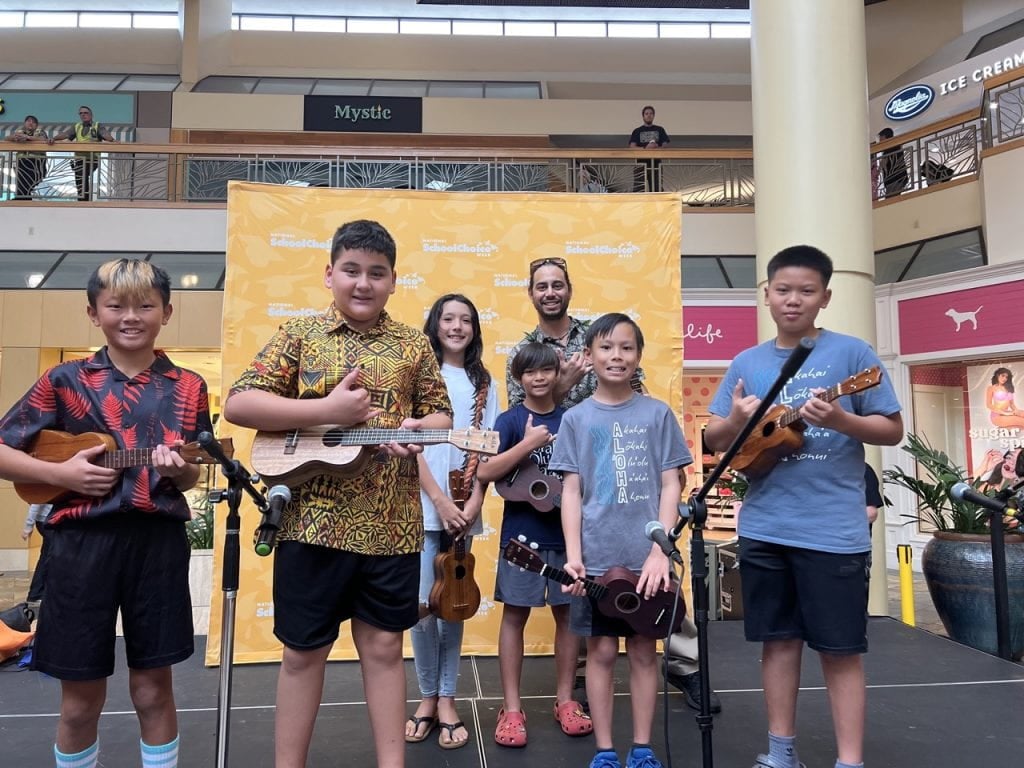
This past weekend, at the Hawaiʻi Parents & Schools Expo, our team greeted parents and families exploring the myriad of educational choices across the island. Throughout the day, different schools showcased their choirs and halau hula. Standing out was our very own students performing on the ukulele led buy Kumu Jonah Cazimero. Mahalo to Kumu Jonah and his haumana for entertaining the crowd and showing everyone the talent at Kāneʻohe Elementary.
INVITATION TO SHARE

Every morning at piko, we invite students and staff to share their stories and reflection on the Aloha Focus of the Week. Starting this week, we invite ʻohana to join in the sharing. At minimum, we encourage you to talk with your children about the Aloha value and positively reinforce their practice. However, if you would like to share with our school community, please email or call me to schedule a time for your sharing – even if it’s to ask if I can share your message on your behalf. I look forward to hearing from you.


CONTINUED PRACTICES:

NOʻAHUNA OF ALOHA

See Uncle Pono Shim explain the Noʻahuna, the esoteric meaning, of Aloha as taught to him by Aunty Pilahi, the Keeper of Secrets.

WEAR KĀNEʻOHE SHIRT WEDNESDAYS

Help us build unity and show our lōkahi by wearing a shirt that celebrates Kāneʻohe on Wednesdays. Wear any previous Fun Run or grade level shirt.

DAILY VIRTUAL PIKO

At the Daily Piko, we share thoughts on the Aloha value for the week which helps us become centered and ready to learn. We begin at 8 AM everyday except Wednesdays.


UPCOMING EVENTS

Jan 29KES SCC Mtg – Online @Zoom4:30 – 5:30 PM
Feb 3 – 7National School Counseling WeekTheme: Helping Students Thrive. National School Counseling Week highlights the tremendous impact school counselors have in helping students achieve school success and plan for a career.
Feb 13Kindergarten Preview5:30 – 6:30 PM
Feb 14Institute Day – no students

DR. MARTIN LUTHER KING JR’S VISION & LŌKAHI

Everything in the reef is connected. The fish rely on the reef to survive. The fish, the water, the reef, and the land are interconnected. There is lōkahi when the ecosystem is healthy.

Ke Ku‘una Na‘au

On September 17, 1959, less than a month after Hawaiʻi became a state, Dr. Martin Luther King Jr. visited Honolulu and spoke to members of our legislature. Looking across his interracial audience, far different from the politicians on the continent, Dr. King lauded Hawaiʻi as “a noble example” of progress “in the area of racial harmony and racial justice.” During his speech to the House of Representatives, Dr King said, “This [solving racial inequality] is not our struggle today to free 17,000,000 Negroes. It’s bigger than that. We are seeking to free the soul of America. Segregation debilitates the white man as well as the Negro. We are to free all men, all races and all groups. This is our responsibility and this is our challenge and we look to this great new state in our Union as the example and as the inspiration. As we move on in this realm, let us move on with the faith that this problem can be solved and that it will be solved, believing firmly that all reality hinges on moral foundations and we are struggling for what is right and we are destined to win.”

ALOHA FOCUS FOR THE WEEK: LŌKAHI

Pono Shim taught us that amongst its many definitions, lōkahi is “a desire for harmony from within and from that peaceful place looking for the “one story” or the “story from heaven’s perspective” where there are no sides (walls, prejudices, biases, silos, agendas).” To this end, Dr. King sought to find the lōkahi – the heavenly perspective – on how we are to live with each other, treat one another and heal all. 

While Dr. King regarded Hawaiʻi as model for the rest of the nation, he also noted in his speech, “You see, it would be a fact for me to say we have come a long, long way but it wouldn’t be telling the truth. A fact is the absence of contradiction but truth is the presence of coherence. Truth is the relatedness of facts. Now, it is a fact that we have come a long, long way but in order to tell the truth, it is necessary to move on and say we have a long, long way to go. If we stop here, we would be the victims of a dangerous optimism. We would be the victims of an illusion wrapped in superficiality. So, in order to tell the truth, it’s necessary to move on and say we have a long, long way to go.”

Dr. King praised advances made in the effort to pass the Civil Rights Act, eliminating lynching of blacks, strengthening voter right laws, and increasing economic prosperity of Americans of African descent. But then he countered those advances with areas still alarmingly in deficit including the bombing of churches, homes, and schools that were occurring in the South; continued efforts to suppress voting; continued lack of economic opportunities; and the continuation of segregation. Keep in mind, that when Dr. King spoke, passage of the Civil Rights Act was still five years away, African Americans were still being denied service at lunch counters, and racially biased housing   practices were still in effect well into the 1970s and beyond.

Perhaps as Dr. King looked across the legislators, he may have noted out of the 51 members of the House, only two were women. He may have also saw that while Caucasians were in the minority, Japanese Americans formed the vast majority while Native Hawaiians comprised 10% of the body, despite making up at least 20% of the overall population. Other racial groups such as those of Filipino descent were largely under represented. Perhaps unbeknownst to Dr. King, examples of segregation in Hawaiʻi’s schools were within three mile radius of the capitol. English Standard Schools were on their last legs but still guaranteed children whose parents spoke English (and were largely Caucasian) did not need to intermingle with those of recent, non-English speaking immigrants. As a state, we may had been further ahead than those on the continent, but in terms of being a manifestation of Dr. King’s dream, we still had (and have) a long, long way to go.

Eventually, when Dr. King returned home, he shared with is congregation what he saw in Hawaiʻi. He may have taken an overly optimistic perspective, but it is still one that feels true and defines the heavenly view we strive to attain. “As I looked at all of these various faces and various colors mingled together like the waters of the sea, I could see only one face– the face of the future!” (“Dr. King Reports on Trip to Hawaii,” Dexter Echo, 4 November 1959).


5 PURSUITS of LŌKAHI

Inspired by Gholdy Muhammad

Please watch this: The Boxitechs written and illustrated by Kim Smith. Then with you child, answer the following:

  • IDENTITY: What are different ways your family works together? Think of several examples and explain the role each person in your family plays. 
  • SKILLS: What caused Meg and Simone to decide to collaborate? Why do you think Meg thought it would be a better idea than working by herself? Use evidence from the text to support your answer.
  • INTELLECT: What is the difference between cooperation and collaboration?
  • CRITICALITY: The kupuna in ancient times worked together in the ahupuaʻa to sustainably feed themselves and help each other survive. Today, what lessons from the past could we use to solve the problems our community face today?
  • JOY: Work with someone in your family to build something creative out of cardboard. 

INVITATION TO SHARE

Every morning at piko, we invite students and staff to share their stories and reflection on the Aloha Focus of the Week. Starting this week, we invite ʻohana to join in the sharing. At minimum, we encourage you to talk with your children about the Aloha value and positively reinforce their practice. However, if you would like to share with our school community, please email or call me to schedule a time for your sharing – even if it’s to ask if I can share your message on your behalf. I look forward to hearing from you.


CONTINUED PRACTICES:

NOʻAHUNA OF ALOHA

See Uncle Pono Shim explain the Noʻahuna, the esoteric meaning, of Aloha as taught to him by Aunty Pilahi, the Keeper of Secrets.

WEAR KĀNEʻOHE SHIRT WEDNESDAYS

Help us build unity and show our lōkahi by wearing a shirt that celebrates Kāneʻohe on Wednesdays. Wear any previous Fun Run or grade level shirt.

DAILY VIRTUAL PIKO

At the Daily Piko, we share thoughts on the Aloha value for the week which helps us become centered and ready to learn. We begin at 8 AM everyday except Wednesdays.


UPCOMING EVENTS

Jan 29KES SCC Mtg – Online @Zoom
4:30 – 5:30 PM
Feb 3-7National School Counseling Week Theme: Helping Students Thrive.  National School Counseling Week highlights the tremendous impact school counselors have in helping students achieve school success and plan for a career.
Feb 14Institute Day – no students

APOLOGIES AS AKAHAI

Mai kū me ka hō’olo, akā e kū me ke akahai. 

Don’t stand in an air of superiority, but stand in modesty.

ALOHA FOCUS FOR THE WEEK: AKAHAI

The standard playground apology sounds something like, “I’m sorry. I won’t let it happen again.” But does it truly mean the offender is sorry? And does it guarantee that he/she won’t do whatever it was again? In most cases, the answer to both of those questions is “no.” And this is evinced by the number of times we see the same kids doing the same things over and over again. So how might we more effectively teach students to reflect on what they’ve done, repair any harm they’ve caused, and sincerely try to avoid making the same mistakes?

Having been one of those kids (I used my wit and words to tease and belittle others) I draw from my experiences. I only was able to break the cycle when I reshaped my perspectives of what an apology is and what it looks like. When I was younger, I saw apologizing as a sign of weakness and it meant admitting that I was a bad person. So any apology I made was halfhearted. It was often peppered with an excuse for my behavior. “I’m sorry for making you cry but I was just joking.” Or laid the blame on the other person, “…he started it.” 

Because of my warped views on apologies, I felt angry that I was made to apologize and so I distanced myself from accepting blame by putting it on the other person “I’m sorry you feel angry” and then expected everyone to just move on “what? I said I’m sorry! Just move on!” But we couldn’t move on because I didn’t sincerely think about my actions and the harm I caused. I didn’t accept my kuleana and how I would repair my wrong.

Eventually I realized the pain I caused along with the injury to my own self-perception I suffered from hanging with people who engaged in the same bad behavior. I realized that I needed to stop disguising my words as humor in order to disparage others. Putting others down did not elevate me. Instead, I felt cruel and damaged.

A few of my YMCA mentors, Clayton Segawa and Baron Gushiken, helped me see how I could better use my wit and words to lead, inspire and lift others. Their guidance made me realize that I also needed to use my words to resolve my offenses as apologizing was a part of strengthening my leadership. They helped me see that everyone at some point hurts others. It’s unavoidable. And if we don’t treat that wounds we cause, it may fester, become infected, and ultimately damage ourselves and our relationships. However, if we work on healing the harm, then we and our relationships become stronger and more resilient. 

The Japanese practice of kintsugi, where broken pottery is bonded with lacquer and decorated with gold powder, elevates the beauty of once pristine pieces of art. It acknowledges the ephemeral, fragile nature of life and shows how we can extend our usefulness and value. Like kintsugi, a true apology not only makes one whole again, it strengthens us…leaves us better.


5 PURSUITS of AKAHAI

Inspired by Gholdy Muhammad

Please watch this: Golden Threads written by Suzanne Rizzo & Illustrated by Miki Sato. Then with you child, answer the following:

  • IDENTITY: Do you have any scars from an injury? What is the story behind that scar?The Japanese believe we develop scars over our lifetime and should not hide them. Instead scars can give way to something new and beautiful. Ask your kupuna to share stories about any scars they may have.
  • SKILLS: Watch the video again to find all the ways the author uses metaphor and simile to describe different things fox sees and experiences.
  • INTELLECT: In the story, Kiko uses golden thread to mend fox and not just repair him, but make him even more uniquely beautiful. This is similar to how ceramists in Japan use the art of kintsugi to repair broken cups and dishes. Research kintsugi and the philosophy of celebrating flaws.
  • CRITICALITY: How might we show akahai and celebrate our flaws and help others become more uniquely beautiful?
  • JOY: With the help of a makua (adult), repair something to extend it’s life and usefulness. See the beauty in it’s imperfections.

BONUS: read about how Hawaiian craftspeople performed a similar repair method using wood that valued reusing and adding beauty to everyday objects.


KINDERGARTEN REGISTRATION AND GES

With the start of the new year, we are accepting kindergarten registration and requests for Geographic Exceptions (GEs) for SY 2025-26. If you, or someone you know, has a child that turns 5 by July 31, 2025, please register ASAP. If you live outside of the Kāneʻohe Elementary boundaries, the deadline to submit GEs is March 1, 2025. Please be mindful of this deadline, as any GE received after March 1st will be placed on a wait list.

We are also accepting Geographic Exceptions (GE), for students entering grades 1 through 6. If you have any questions about registering your child, please call our registration clerk, Brigette Leavy, at 305-0001 or email her at Brigette.Leavy@k12.hi.us.


CONTINUED PRACTICES:

NOʻAHUNA OF ALOHA

See Uncle Pono Shim explain the Noʻahuna, the esoteric meaning, of Aloha as taught to him by Aunty Pilahi, the Keeper of Secrets.

WEAR KĀNEʻOHE SHIRT WEDNESDAYS

Help us build unity and show our lōkahi by wearing a shirt that celebrates Kāneʻohe on Wednesdays. Wear any previous Fun Run or grade level shirt.

DAILY VIRTUAL PIKO

At the Daily Piko, we share thoughts on the Aloha value for the week which helps us become centered and ready to learn. We begin at 8 AM everyday except Wednesdays.

UPCOMING EVENTS

Jan 15KES Ohana Mtg via Zoom and in-person @KES Library
5:30 – 6:30 PM
Jan 29 KES SCC Mtg – Online @Zoom
4:30 – 5:30 PM
Feb 3 – 7National School Counseling Week Theme: Helping Students Thrive.  National School Counseling Week highlights the tremendous impact school counselors have in helping students achieve school success and plan for a career.
Feb 14Institute Day – no students

THE PATIENCE, PERSISTENCE AND RESILIENCE OF AHONUI

Ua ahonui nō ʻoe i nā pōpilikia.

You have been patient in the times of trouble.

Pukui, Mary Kawena, Elbert, Samuel H. (1965). Hawaiian Dictionary

ALOHA FOCUS FOR THE WEEK: AHONUI

With 2024 in the past and the new year opening with an astringent mix of shock, regret, and promise, I’ve been filled with nostalgia – but not one in which I long for or idealize the past. Instead, I have been reflecting on the struggles we faced and overcame and still others that continue to trouble us. This time of reflection helps me to appreciate the progress we’ve made, respect the challenges ahead and hold hope for what we can accomplish.

Recently, while in a wistful mood, I listened to Resistance, one of my favorite podcasts that is no longer produced. Born out of the Black Lives Matter movement, Resistance explored the many ways people resist the current “normal.” One of the episodes featured a vignette by poet, performer and social activist Dominique Christina and her grandfather, Byron Waldo Emerson Johnson. Christina recounts a time during her college years when she naively lectured her grandfather about the docility of older generations. Her grandfather’s response helped her contemplate the context of older generations, “Okay, I hear you. And you get to feel all of that from here. But where would you have been on the plantation? You know, the enslaved person, born in the context of slavery— You know how radical an act it was for them to just even try on the idea of liberty? Just to imagine that maybe liberty could belong to them, too. Just that thought: how radical it would be for the person born in the context of slavery to just get their brain to generate that thought is radical.”

In some ways, Dominique Christina’s grandfather spoke to Ahonui – waiting for the moment – or knowing when is the right moment to act and in what measures. For the civil rights movement, change comes incrementally and in some ways painfully slow. Yet it progresses through acts of resistance both big and small, flashy and subtle. Ahonui is about those small and subtle acts. It is about having patience, persistence, and resilience.

Acknowledging that we cannot solve all of our problems at once, each step forward brings us closer – even when conditions cause us to retreat temporarily. During the break, I recounted the skirmishes and bitterness of the past that once plagued us – even once having to break up an argument at risk of becoming physical. This exercise helped me recognize the progress made stemming from our collective efforts to infuse our culture with aloha. Far from perfect, ahonui sustains our efforts and fills us with patience, persistence and resilience.


5 PURSUITS of AHONUI

Inspired by Gholdy Muhammad

Please watch this: New Day’s Lyric written and recited by Amanda Gorman. See the full text of the poem here. Then with you child, answer the following:

  • IDENTITY: Amanda Gorman wrote this poem for New Year’s Day 2022, when we were still at the height of the COVID pandemic. Talk with you kupuna how your ʻohana had ahonui and held out hope for better days.
  • SKILLS: How does Gorman use repetition in her poem? How does it make you feel and think of when uses repetitious phrases?
  • INTELLECT: As a kindergartener, the author Amanda Gorman was diagnosed with an auditory processing disorder in kindergarten which made it difficult for her to understand certain words and sounds. Research how she overcame learning challenges to eventually become the National Youth Poet Laureate and graduate cum laude from Harvard University.
  • CRITICALITY: How does Gorman incorporate akahai, lōkahi and ahonui to recognize how we can move past our struggles and into a more hopeful future? 
  • JOY: Write your own poem of hope for the new year.

CONTINUED PRACTICES:

NOʻAHUNA OF ALOHA

See Uncle Pono Shim explain the Noʻahuna, the esoteric meaning, of Aloha as taught to him by Aunty Pilahi, the Keeper of Secrets.

WEAR KĀNEʻOHE SHIRT WEDNESDAYS

Help us build unity and show our lōkahi by wearing a shirt that celebrates Kāneʻohe on Wednesdays. Wear any previous Fun Run or grade level shirt.

DAILY VIRTUAL PIKO

At the Daily Piko, we share thoughts on the Aloha value for the week which helps us become centered and ready to learn. We begin at 8 AM everyday except Wednesdays.

UPCOMING EVENTS

Jan 6PC Day – No students
Jan 7Teacher Work Day – No students